An incredible incident made Jayaprakash Narayan to agree to the plea of Nanaji and Ramnathji to lead the movement against Indira Gandhi. I came to know of this in the late 1980s when at a dinner in the Express Towers in Bombay I asked Nanaji and Ramnathji how they brought JP into the movement. Nanaji described the thrilling and unbelievable episode. A historic meeting of Ramnathji, Nanaji, Achyut Patwardhan, the hero of the 1942 underground movement and Ramdhari Singh Dinkar, a great Hindi poet, took place sometime in 1973 in the Indian Express Guest House in Bangalore. Ramnathji, Nanaji, Ramdhari Singh Dinkar and Achyut Patwardhan, began insisting that JP should lead the movement as Indira Gandhi had become highly autocratic and had begun destroying the institutional framework of democracy including the judiciary and bureaucracy. Incidentally, Dinkar was one of the greatest friends of the Nehru family and particularly of Indira Gandhi herself. But that did not detract him from doing what he thought was his duty to the nation. JP was hesitant mainly because of his health. He was a diabetic and had acute prostrate gland issues. He said that he would not be able to live for long and his health did not permit him to undertake such an arduous task. Ramnathji assured him that he would have his prostrate operation done in Vellore, which he eventually got done later. But JP could still not make up his mind. At that point, Ramnathji suggested that all of them should go to Tirupati, have darshan and prayers and from there, go to Madras as it was known then, and continue the discussions. And they all left for Tirupati.
During the darshan at Tirupati, Ramdhari Singh Dinkar openly prayed to Lord Balaji, to the hearing of JP and the others, that whatever remaining years of life Dinkar had the Lord should give them to JP to help him serve the cause of the motherland. And they all returned to Madras and to Ramnathji’s house in the Express Estates in Mount Road. Within hours Ramdhari Singh Dinkar fell on the lap of Ramnath Goenka and died — yes he died when JP, Nanaji and Achyut Patwardhan were around. It was clear that Lord Balaji had answered Dinkar’s prayers. JP’s decision to lead the movement came in no time. Despite my several requests Nanaji had refused to write about it in the Indian Express. When I asked him how will the people of India know about it, he said that he had written in his diary and he would like it to be known after his death. Now that he is no more I felt free to write about it.

Monday, March 1, 2010
How Lord Venkateswara Helped Fight Indira's Tyranny in 1974
Remembering Nanaji Deshmukh, RSS and Jan Sangh leader, and founder of mostly defunct Deendayal Research Institute, a think tank, on the eve of his death, at age 94, S. Gurumurthy recalled a remarkable story that Nanaji narrated to him about what lead Jay Prakash Narayan to lead the fight against the absolutely corrupt and tyrannical Indira Gandhi's rule in early 1970, when she rolled out her socialist programs, destroying the already dying Nehru's command economy, and destroyed the constitutional separation of judiciary and executive branch. (Does communism and socialism exist in another kind?)


Bring Saudi Arabia into IBSA Before Making it a Mediator in Indo-Pak Dialogue
Getting Saudi Arabia to Play a Fair and Quite Role is Key
Despite Sashi Tharoor pronouncements and retractions, we are sure India has sought Saudi Arabia's help in reining in various Islamic terrorists groups supported by Pakistan that create death and destruction in Indian cities with regular frequency. Saudi is the main financier of increasingly bankrupt and strife-ridden Pakistan. Being an Islamic country that doesn't think that it's the greatest gift to mankind, with immense oil and energy resources, and influence in Pakistan, unlike the erratic US, Saudi may actually be a asset to India during it's long winding and ever changing negotiations with Pakistan.
Saudi would surely be better than China in the role of quite mediator - for example, India could have talked to Pakistan via Saudi, quietly, instead of via US, which ends up using the situation for its own advantage, on what Pakistan was willing to do, soon after Mumbai Islamic terror attacks on 26/11. May be Pakistan will not play so many double games if it gives its word to Muslim Saudi instead of to Christian US - when Pakistan follows Islamic practice of lying to non-Muslims to win a battle/war (we forget the exact Quranic word that convey the meaning of this war/negotiation strategy of Islamic groups/countries). In fact, assurances made to Pakistan to Saudi may be more binding then those made to US or India.
Of course Saudi, being an Islamic country itself, may also practice the art of lying to non-Muslim India. But we would like to think Saudi, if it does so, has more to lose strategically and financially unlike morally bankrupt Pakistan. To bring Saudi into that strategic and financial reliance on India, we must first open up to Saudi Arabia.
While the current visit by Manmohan Singh, first visit by Indian PM since Indira in 1982, has been well received, despite Tharoor tamasha, we have to go a step further.
We should have, after consulting with South Africa and Brazil, brought Saudi Arabia into the IBSA strategic initiative as Saudi is also a major littoral state. IBSA has been one Indian initiative that has been a success and has potential to be substantive if we play it right. Bringing in Saudi into a strategic framework of a global group would make Saudi a responsible and viable country. Saudi would then, one would hope, play a fair and quite mediator role between the troubled Pakistan with its negotiations with India.
We see little downside to Saudi being a quite go in-between between India and Pakistan. Surely Saudi would play the role much better than US or China. But in order for Saudi Arabia to play its role fairly, we should bring Saudi along to the global stage and take the relationship beyond an economic one.
Despite Sashi Tharoor pronouncements and retractions, we are sure India has sought Saudi Arabia's help in reining in various Islamic terrorists groups supported by Pakistan that create death and destruction in Indian cities with regular frequency. Saudi is the main financier of increasingly bankrupt and strife-ridden Pakistan. Being an Islamic country that doesn't think that it's the greatest gift to mankind, with immense oil and energy resources, and influence in Pakistan, unlike the erratic US, Saudi may actually be a asset to India during it's long winding and ever changing negotiations with Pakistan.
Saudi would surely be better than China in the role of quite mediator - for example, India could have talked to Pakistan via Saudi, quietly, instead of via US, which ends up using the situation for its own advantage, on what Pakistan was willing to do, soon after Mumbai Islamic terror attacks on 26/11. May be Pakistan will not play so many double games if it gives its word to Muslim Saudi instead of to Christian US - when Pakistan follows Islamic practice of lying to non-Muslims to win a battle/war (we forget the exact Quranic word that convey the meaning of this war/negotiation strategy of Islamic groups/countries). In fact, assurances made to Pakistan to Saudi may be more binding then those made to US or India.
Of course Saudi, being an Islamic country itself, may also practice the art of lying to non-Muslim India. But we would like to think Saudi, if it does so, has more to lose strategically and financially unlike morally bankrupt Pakistan. To bring Saudi into that strategic and financial reliance on India, we must first open up to Saudi Arabia.
While the current visit by Manmohan Singh, first visit by Indian PM since Indira in 1982, has been well received, despite Tharoor tamasha, we have to go a step further.
"We deeply value Saudi Arabia's role as a reliable partner in meeting our energy needs. We believe that conditions are ripe for moving beyond a traditional buyer-seller relationship to a comprehensive energy partnership," he [PM] said.
"India sees Saudi Arabia as a strategic partner for promoting peace, stability and economic development. Such a partnership will bring benefits not only to our two countries but to the region we both belong to, and to the world at large," the PM said.
The Saudi industry captains said India should grant multi-entry visa to ease movement of businessmen and clear hurdles in investment funds. They said there was tremendous scope for cooperation in the oil, power and IT sectors.
Singh said Indian companies are well-equipped to participate in upstream and downstream oil and gas sector projects in Saudi Arabia. "We should also establish new partnerships in the area of new and renewable energy through sharing of clean technologies and joint collaborations," he said.
Saudi Arabia is India's fourth largest trading partner with two-way commerce being to the tune of about $ 25 billion.
We should have, after consulting with South Africa and Brazil, brought Saudi Arabia into the IBSA strategic initiative as Saudi is also a major littoral state. IBSA has been one Indian initiative that has been a success and has potential to be substantive if we play it right. Bringing in Saudi into a strategic framework of a global group would make Saudi a responsible and viable country. Saudi would then, one would hope, play a fair and quite mediator role between the troubled Pakistan with its negotiations with India.
We see little downside to Saudi being a quite go in-between between India and Pakistan. Surely Saudi would play the role much better than US or China. But in order for Saudi Arabia to play its role fairly, we should bring Saudi along to the global stage and take the relationship beyond an economic one.
Saturday, February 27, 2010
Those Law Suit Filing Hindu Fundamentalists - M. F. Husain
Times of India News Digest on front page first article on Friday had this recap of M. F. Husain's troubles in India when declaring that he became a Qatar citizen:
So let's get this straight, some Hindus filed court cases instead of murdering or beheading him as Islamic groups would do for apparent slander of Islam and these Hindus are "fundamentalists!" And the guy who fled the country after the cases were filed, instead of fighting for what he believes in, has artists around the "world" in anger. No wonder our judicial system is in shambles with all the lakhs of "fundamentalists" filing cases for criminal and civil dispute cases. In our opposite world, Indian secularists would say those Islamic groups that behead, instead of file court cases, are following the law.
Let us present the reason why thinking Hindus are offended by "great artist" M. F. Husain's painting of Hindu Gods. Has anyone noticed that none of Indian secularists and their media apologists ever tell us what the painting are about or perhaps publish them. While looking at the pictures (obtained from here) of Husain's painting, see the caption of first painting to see why Husain expresses his Hindu hatred in naked figures of Hindu Gods.
 Einstein, Gandhi, Mao, and Hilter (Apparently Husain hates Hilter and paints him naked. Notice Das Kapital of Mao - no wonder left wingers love him so much)

Husain's Mother

Husain's Daugther

A Muslim woman

Fatima (Islam's founder Mohammad's daughter)

Teresa (although she's not known for playing with children, perhaps the naked brown boy means something)

Muslim Poets - Faiz and Galib
Paintings of Hindu Deities and Hindu men


Parvati Devi (naked with Ganesha)
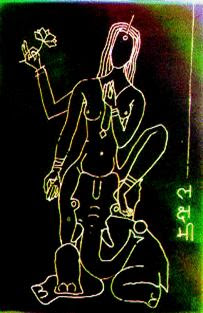 Lakshmi Devi (sitting on elephant naked)

Saraswati Devi (with her Veena, naked in water holding a lotus, perhaps drowning)
 Sita Devi, Ravana, and Hanuman (not only is Sita naked, she's sitting on Ravana's lap, with his penis hanging, when Hanuman arrives!)
Draupati (ugly and presumably getting stripped)

Warrior Muslim ready to slay a naked Hindu

Of course, the naked Bharatmata herself
This is also another case of fundamentalist equivalency. M. F. Husain, perhaps being a Muslim, and his liberal left wing artists elk think that Hindus outraged by Husain's salacious paintings depicting Hindu Gods, would behave exactly like Islamic fundamentalists, even if they had already filed "law suits" in court of law.
We are told M. F. Husain has accepted Qatar citizenship out of fear for his arrest in India. Perhaps now Husain will have the freedom to paint naked Qatari gods be appreciated by liberal Qatari people and the art world can celebrate the "art" of the great "artist."
News of Husain's new nationality created ripples in the art world and triggered anger of the government's failure to bring home the artist who was forced to flee India in 2006 and flit between Dubai and Londan as criminal cases filed by fringe Hindu extremist groups alleging he had defiled deities by depicting them obscenely piled up in Indian courts. Last year, the Supreme Court clubbed all nine cases against Husain and transferred it to a Delhi magistrate's court in a bid to clear the mess. But no hearing was held and no clear order absolving him came. He felt he was still liable for arrest on Indian soil and never came back.
So let's get this straight, some Hindus filed court cases instead of murdering or beheading him as Islamic groups would do for apparent slander of Islam and these Hindus are "fundamentalists!" And the guy who fled the country after the cases were filed, instead of fighting for what he believes in, has artists around the "world" in anger. No wonder our judicial system is in shambles with all the lakhs of "fundamentalists" filing cases for criminal and civil dispute cases. In our opposite world, Indian secularists would say those Islamic groups that behead, instead of file court cases, are following the law.
Let us present the reason why thinking Hindus are offended by "great artist" M. F. Husain's painting of Hindu Gods. Has anyone noticed that none of Indian secularists and their media apologists ever tell us what the painting are about or perhaps publish them. While looking at the pictures (obtained from here) of Husain's painting, see the caption of first painting to see why Husain expresses his Hindu hatred in naked figures of Hindu Gods.
 Einstein, Gandhi, Mao, and Hilter (Apparently Husain hates Hilter and paints him naked. Notice Das Kapital of Mao - no wonder left wingers love him so much)
Painting of Muslims - Women and Men

Husain's Mother

Husain's Daugther

A Muslim woman

Fatima (Islam's founder Mohammad's daughter)

Teresa (although she's not known for playing with children, perhaps the naked brown boy means something)

Muslim Poets - Faiz and Galib
Paintings of Hindu Deities and Hindu men

Durga Devi (with, perhaps in bestial act, her loin, naked)

Parvati Devi (naked with Ganesha)
 Lakshmi Devi (sitting on elephant naked)

Saraswati Devi (with her Veena, naked in water holding a lotus, perhaps drowning)
 Sita Devi, Ravana, and Hanuman (not only is Sita naked, she's sitting on Ravana's lap, with his penis hanging, when Hanuman arrives!)

Draupati (ugly and presumably getting stripped)

Warrior Muslim ready to slay a naked Hindu

Of course, the naked Bharatmata herself
This is also another case of fundamentalist equivalency. M. F. Husain, perhaps being a Muslim, and his liberal left wing artists elk think that Hindus outraged by Husain's salacious paintings depicting Hindu Gods, would behave exactly like Islamic fundamentalists, even if they had already filed "law suits" in court of law.
We are told M. F. Husain has accepted Qatar citizenship out of fear for his arrest in India. Perhaps now Husain will have the freedom to paint naked Qatari gods be appreciated by liberal Qatari people and the art world can celebrate the "art" of the great "artist."
Changing the Current Left Wing Ideological Narrative - 2010 Budget
While our take on the 2010 Congress I budget is largely negative, at least we are happy to report on a data point in the change in ideological narrative. Instead of quoting sundry left wing populist Marxist economists, such as Amartya Sen, Pranab Mukherjee has quoted Kautilya's Artha Shastra three times during the budget presentation on the wisdom of lower taxes and wisdom of reduced government burden, meaning free economy and open trade, on economic life of people.
We celebrate this data point in the change in ideological narrative towards the right.
Kautilya, who was prime minister in the court of King Chandragupta Maurya, a contemporary to Alexander, in fourth century BC, was mentioned in another Budget presented by Yashwant Sinha in 1999-2000 as the then finance minister in the NDA government.
Delivering his budget speech for 2010-11, Mukherjee said, "While formulating them (tax proposals), I have been guided by the principles of sound tax administration as embodied" in the words of Kautilya.
He further quoted Kautilya: "Thus a wise Collector General shall conduct the work of revenue collection. . . in a manner that production and consumption should not be injuriously affected. . . financial prosperity depends on public prosperity, abundance of harvest and prosperity of commerce among other things."
We celebrate this data point in the change in ideological narrative towards the right.
Still Tinkering With the Economy in 2010
Annual Indian socialist budget tamasha was yesterday. In the intense debated leading up to and after the budget presentation, no one asked the question, "Will (Is) our economy more free than it was before budget?"
Based on the highlights, while we like the tax cuts on all income groups and dismayed at non-increase in defence spending at this hour of peril, similar to the disastrous Manmohan policies of under spending on defence to control growing deficits in early 1990s, overall government of India still has way too much control over people's economic lives and Congress I is still tinkering with each and every government controlled lever instead of dismantling the entire socialist economic machine.
Why exactly BJP is boycotting the budget and will vote against it? If BJP wants to agitate against food inflation, what are its ideas that were not included in the budget that could have controlled inflation of basic goods? While politically taking on Congress I over the unpopular petrol/diesel price increase is understandable, we are not sure BJP should vote against the bill itself. We agree with BJP that the budget can be better. We hope BJP proposes alternative budget ideas, if only clarify its own economic message.
We have highlighted one reason for food inflation is the reduced yields of food crops because of perverseness of Urea subsidy put in place due to fertilizer industry rent seeking lobby. We were hoping for complete elimination of subsidies for fertilizer industry. It was not to be, but perverseness of Urea subsidy has been replace by subsidies based on nutrient of fertilizer. So socialism and rent seeking of fertilizer industry will continue, but at least impact on food crop yields will be reduced.
There is nothing about complete divestment of public sector firms which are still a huge drag on Indian economy - such as "Rs 16,500 crore to public sector banks to maintain tier-I capital" - although there are plans to divest in tiny increments to "raise Rs 25,000 crore from disinvestment of its stake in state-owned firms." We would wager that funding would be provided to government banks but divestment target money will not raised by this time next year. We are not sure if the "apex-level Financial Stability and Development Council" has mandate to make Mumbai an international financial center on par with Hong Kong, Tokyo, New York, and London.
Overall the tinkering of socialist Indian economy by the current government continues.
Thursday, February 25, 2010
Swapan's BJP Revival Assessment Follow Current Ideological Template
It's Time We Change the Narrative Template
Swapan Dasgupta wrote an upbeat assessment of BJP revival under the leadership Nitin Gadkari. Although we like current leadership of BJP under Gidkari, Sushma Swaraj, Arun Jaitley, all at center level, along with various chief ministers at state level such as Narender Modi, Shivraj Singh, Vasundhara Raje Scindia (hoping that she takes the reins of BJP in Rajasthan soon), and B.S. Yeddyurappa, we think it is premature to talk of revival of BJP until it follows a prescription for conservatism that we propose in our defense of right wing ideology. Even if premature, we don't have issue with Swapan Dasgupta's assessment. What we do have problem with Swapan's inclusion of standard prescriptive mention of the left wing template that (1) whenever Modi's name is brought up, the sentence has to included to mention the 8-year old Godhara riots, and (2) bashing of BJP's so called Hindu nationalism ideology.
While we are dismay at Swapan using template (1) because he, and others like him, need to stop using the standard template of left wing ideologues - it is a first step in changing the current standard ideological narrative, which is entirely herded by left wingers of the country, we are more concerned about Swapan's swipe at the apparent BJP's Hindu nationalist ideology. Where exactly is this ideology? When did BJP, as an political party, propose an agenda to convert India into a Hindu state? If that's not what bothers Swapan, what exactly is Hindu nationalism then? Does BJP's interest in building a Rama temple at Babri Masjid, which was build at the spot by Babar precisely because it was Rama temple at Ayodhya, birth place of Ram. (Secularists may want proof of Ayodhya being the birth place of Ram, but Barbur didn't. Hindus believe itself was enough for him to dismantle the temple and build a masjid on it at Ayodhya.) Even if right wing secularists follow the left wing standard narrative on the issue, how does BJP, with this agenda, convert the state of India into a Hindu state shredding the constitution?
If Rama temple of Ayodhya wasn't Swapan's concern but the recent Shah Rukh Khan flap that Islamic terrorism sponsoring Pakistan was a "great neighbour" was, then surely it would be guilt by association. If anything BJP position was not even to mock Shah Rukh Khan's badge of good neighbour to Pakistan but simple to say that Shah Rukh Khan himself was patriot. How exactly does this represents BJP's Hindu nationalism is a mystery.
This mystery can easily be understood by looking at who creates the ideological narrative template and who follow that template defensively. This current ideological narrative template can't be countered by being a centrist bull. We have to become herders ourselves, stop being defensive, and create our own right wing counter ideological narrative.
Tuesday, February 23, 2010
Why Being Centrist Won't Work in India
On Being A Proud Right-winger
One can describe the current Indian ideological model using a simple model of, what else, cattle farm. The herders set the ideological narrative and the cattle follow that ideological narrative. Many follow the standard ideological narrative because they are ignorant of ideology – even if they are going to own their slaughter. A few thinking cattle, let us call them bulls, understand the current destructive ideology but are too muddled to stand up to say, “Stop! Let me out of the farm. Let me be free.”
There is a reason to be centrist – meaning ideologically independent – in India. But those centrists, by their neutral stand, also become part the cattle in the farm herded by one ideology or another. Some of these centrists bulls. The bulls among the cattle, who tend to be few and far between, are those who can think for themselves, but do not take ideological sides, mainly because they are too muddled, meaning unable to clarify and distill their thinking, to take sides. Most of these bulls are economic or religious right-wingers but are muddled in their thoughts about Hinduism (in case of economic free-marketers) or about free-markets (in case of Hindu revivalists). Vast majority of the bulls are in the latter camp.
The primary herders of the cattle, including ideological centrists, the bulls, are those who provide left wing ideological narrative. They includes communists, Marxists, so-called rationalists, NGOs, Naxalites, and any numbers of so-called civil society groups that usually act as apologists to the groups mentioned earlier. They are supported and abetted by news and TV media, historians, columnists, and intellectuals of various kinds.
If our challenge is to take on the left wing of India, we can't be centrist cattle because even the bulls are being herded by the current left wing ideological narrative. Our only option is offer an alternative narrative. We have to become the polar opposite right wing herders of the cattle to order rescue the nation from the tyranny of corrupt left wing ideology that has taken over the nation during the 20th century.
It cannot be emphasized enough – we can't offer an alternative narrative to tyranny of left wing ideology that has a firm grip on the nation by being centrists.
The right wing ideology, and it is an ideology, has to offer an alternative to the current intellectual narrative on politics, on economy, on foreign policy, on history, and, equally importantly, on Hindu culture and religion. This ideology has to provide an alternative based on clean life in politics, on economic freedom being pre-requisite for prosperity for all people, on a strong non-defensive (and non-diminutive) foreign and national security policy, on promoting Hinduism revivalism taking a stand against aggressive Christian missionaries and Islamic forces. One can't provide this alternative by being a centrist or by providing half-hearted efforts against firmly established left wing ideological narrative that has dominated public narrative since independence from imperialism from the west. Any centrist ideological narrative will spend mostly defending that it's not a right wing narrative. Any half hearted ideological narrative will be crushed by the left wing establishment that already controls the narrative.
Non-Political Argument
This is not a political argument, meaning this argument is not about converting BJP into a right wing political party or for establishing a new right wing political party, such as reviving the old Swathantra Party. This is an argument for changing the national narrative: (1) where being a free market open trade economy with small government becomes the standard economic narrative; (2) where a strong response to Islamic terrorism and strong stand on national security, when each Indian life is considered precious and important, becomes a standard foreign and security policy narrative; (3) where historic Islamic imperialism, western imperialism, pre-imperialism and pre-Buddha eras become standard historic narrative uncorrupted by political correctness imposed by western Indologists or Marxist historians; and (4) where Hindu revivalists freely referring to Vedas, Upanishads, and Puranas becomes a standard cultural narrative.
The standard narrative has to shift so that the starting point of political arguments are based on right wing ideology, not the other way round as it happens currently. The ideological narrative has to shift so that which ever party stands for elections, it has to follow the right wing ideology narrative - on clean politics, free market open economy, foreign & national security, and cultural issues - else it should face the prospect of defeat from the centrists and ideological independents voters, because they form the largest swing votes that decide the political fate of parties. This shift in standard narrative cannot be achieved by right wingers being on the defensive that they are not ideological right wingers, but that they somehow are ideological centrists.
Making Right wingers Out of Bulls in the Herd
Of the two categories of bulls that could become right wingers, the Hindu revival centrists who have seen the devastating effect of 60 (and more) decades of socialism and communism on national economic well being, prosperity, social inequity, and general cultural decay will be more willing to join the right wing ideological cause.
The second group of bulls, the free market open economy centrists will be less willing to join the right wingers. This centrist group is worried, and troubled by, mostly rightly so, by the Hindu orthodoxy that still controls Hindu narrative to some extent. This group will follow, not lead, the ideological narrative shift that should take place. In order to count these bulls as supporter, we have to banish Hindu orthodoxy on varnam and on various superstitions that. We can achieve that by following the Hindu revivalist movement pathway. Right winger themselves have to banish the Hindu orthodoxy. If not, the right wingers themselves will be labeled orthodox fundamentalists. Banishing Hindu orthodoxy does not mean wholesale embrace of western liberals and progressives, both of which are versions of left wing ideology. Hindu liberalism of right wingers has to be based on the Hindu cultural foundation of Vedas, Upanishads, and Puranas. But from this solid and vast foundation, we should reject that which does not promote human dignity and freedom of thought and embrace those that promote right to seek knowledge, human values, and dharma in public and private lives. Only when right wingers reject Hindu orthodoxy while embracing Hindu liberalism will the second group of bulls become right winger ideological herders to take on left wing ideological herders.
Examples of Centrist Not Working
While at some level both RSS and BJP are cut from the same cloth, they form an excellent examples of why being a centrist does not work in India. In some ways, the problem relate the origin of RSS itself.
When looking at RSS, one has to ask the foundational question, what exactly does RSS stand for? It apparently is a swayam sevak sangha. And if it's purely a swayam sevak sangha, why does it claim to be a Hindutva, as defined by founder of RSS itself, organization? If it is not religious organization, why does it dabble in Hindu religious and cultural issues (we say dabble because it doesn't contribute)? If it is for economic freedom, as an alternative to statist socialism, to create wealth and prosperity of the nation, why does organization itself look like its in perennial poverty. In fact, RSS is neither for promoting Hindu liberalism nor is it for promoting economic freedom. It's an entirely purposeless organization beyond its great relief work during natural calamities. It is an organization for the sake being an organization.
Going back to farm model, RSS is a sub-farm within the cattle farm, with no ideological bulls, meaning no one providing ideological heft to Hindu liberalism or economic freedom. And yet its always on the defensive that it is a centrist organization and not a “Hindu fundamentalist” organization. The left wing herders standard narrative is that RSS is a large herd of mad cattle just stomping around aimlessly, but a dangerous one in that it could stomp the entire cattle farm itself. And RSS, despite being in existence since Vijayadasami of 1925, does nothing to dispel the narrative created by left wing herders, since its inception, beyond protests and polemics.
And then there is BJP. If there is even a better example of left wing ideological herders setting the ideological narrative of an organization, it has be BJP. While it is a vastly better alternative to Congress I and regional parties in so far as it is not inimical to Hindu liberalism and economic freedom, it provides little ideological muscle to right wing ideology. While it has few right wing ideological intellectuals like Arun Shourie, its leadership, and hence its ideological direction, consists (or consisted until recently) entirely of bulls – from A. B. Vajpayee to L. K. Advani to Jaswant Singh. While they occasionally provide ideological heft for Hindu liberalism, economic freedom, and freedom of thought, like the bulls in the cattle farm, their narrative is controlled by left wing ideological herders.
Despite making India into an overt nuclear state, a significant achievement, Vajpayee follows the left wing ideological narrative from foreign policy issues such as accession of Tibet to China, following left wing Nehru's path, and making peace with Islamic terror sponsoring Pakistan, to cultural battles such as canceling Sita Ram Goel series on historic Islamic imperialism in India that was being published in RSS's publication Organizer, by firing the editor of the publication itself. L. K. Advani follows similar ideological narrative when he almost wept to explain why Ayodhya kar sevaks brought down Babri Masjid, symbol of Muslim imperialism in India, to when he claimed that Mohammad Ali Jinnah actually preached and practiced tolerance towards Hindus taking a single quote which Jinnah himself disowned few days later. Jaswant Singh, the apparent liberal in BJP, put Jinnah on even a higher pedestal dismissing M. K. Gandhi, Nehru, and Sardar Vallabhbhai Patil defense of Indian nationhood of not balkanizing the nascent post-imperial nation into regional autonomous entities based primarily on religion.
Way Forward
So the notion that centrists, in the mold of BJP or other avatars, can provide an alternative narrative to left wing ideology is false and unworkable. Only a right wing challenge to current left standard narrative on economy, on nation security and foreign policy, on history, and on culture will provide the alternative. And this alternative narrative has to be provided by by-passing traditional media outlets like newspapers, current affairs magazines, and TV news. It has to be through web – blogs, magazines, books, popular novels, news collection portals, and radio talk shows all of which allow for more space, time, and energy to offer a right wing alternative narrative while exposing the hypocrisy of the current standard narrative of the left. Of the alternative media available, only radio has the power to reach mass audience until wide spread internet is available. Hence the first task for proponents of right wing alternative narrative is to identify excellent speaking showmen with great command of English, Hindi, and regional languages and provide them multiple platforms to offer commentary on news, politics, and culture and counter current left wing narrative with facts and common sense and plenty of humour to provide the alternative right wing narrative that would become mainstream in due course.
Because the right wing ideological narrative has a higher bar supported by facts, interpretation, and deductive analysis, reactive polemics of kind that are mostly currently used are of little importance. The irrationality and anti-intellectual narrative of left wing ideology can't be countered by using the same irrational and anti-intellectual narrative. The facts, interpretation, and analysis has to done by serious people individually at home and in universities or in collective enterprises such as think tanks and policy impact groups. These people's and institutional narrative has to be the foundation of the alternative right wing narrative propagated by blogs, magazines, books, talk shows, and other outlets in popular formats. The two institutions – fact-driven intellectual and popular narrative forums – have to coexist and be interlinked to make the change in current standard left wing ideological narrative.
This is only way to dismantle the current popular and destructive ideological narrative. And it's not a centrist way.
Subscribe to:
Posts (Atom)